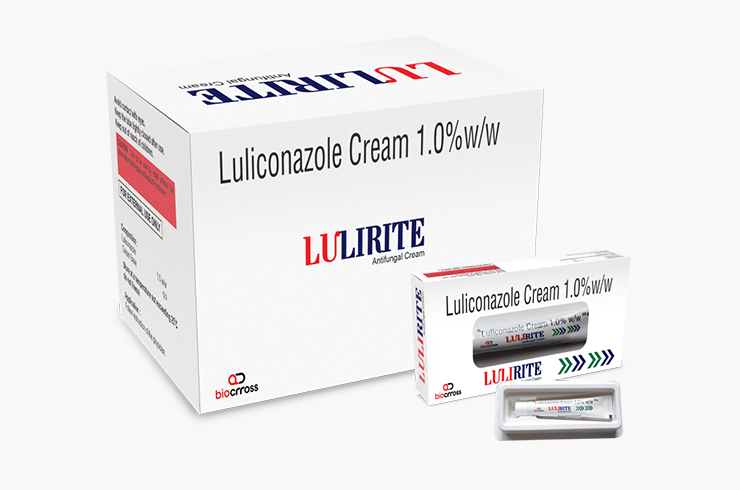
— Product
LULIRITE CREAM
LULICONAZOLE
LULIRITE CREAM is a topical cream containing luliconazole, a newer imidazole antifungal. It is used for tinea corporis, tinea cruris and tinea pedis, and for candidal skin infections, with a shorter treatment course than most older topical antifungals.
01
Benefits
- Luliconazole has high potency against dermatophytes, allowing shorter courses than older topical azoles — often one to two weeks rather than four.
- Once-daily application improves adherence, which is the main determinant of success in topical antifungal treatment.
- Retained in the stratum corneum after the course ends, continuing to act for some days.
- Effective in tinea pedis, including the interdigital form that often resists treatment.
- Low systemic absorption, so it is well tolerated even with daily use.
02
Side effects
Not everyone gets these. Most are mild and settle as the course finishes.
Common
- Mild burning or stinging on application
- Local redness
- Itching at the application site
- Dryness of the treated skin
Less common
- Contact dermatitis with persistent redness and itching
- Peeling of the treated skin
- Worsening of the rash rather than improvement
- Sensitisation on repeated use
Stop and get medical help if any of these occur
- Spreading redness, warmth, pus or increasing pain, suggesting bacterial infection
- Severe blistering or ulceration of the treated skin
- Swelling of the face, lips or tongue, or difficulty breathing
- No improvement after two to four weeks of correct use
- Fever alongside a worsening skin infection
03
Precautions
- For external use only. Avoid the eyes, mouth and inside of the nose.
- Contraindicated in known hypersensitivity to luliconazole or other azole antifungals.
- Apply thinly to the affected area and a margin of two to three centimetres of surrounding normal skin, where the fungus extends beyond the visible rash.
- Complete the full course even after the rash clears; stopping early is the commonest cause of relapse.
- Do not use on the scalp or nails — those sites need oral treatment.
- Keep the area clean and dry, wear loose cotton clothing, and treat household contacts and footwear where reinfection recurs.
- Do not use alongside a topical steroid unless specifically directed; steroids allow fungal infection to spread.
- Seek review if there is no improvement after two to four weeks.